on Posted on
Ocean freight costs have once again become a significant consideration for companies sourcing components and finished goods internationally. Global macro conditions are driving these cost pressures, including the ongoing conflict in the Middle East, increasing fuel costs, increased port congestion, overall vessel capacity and ship re-alignments. These factors are affecting shipping to the US from China, India, and Southeast Asian countries.
Freight costs have moved sharply higher
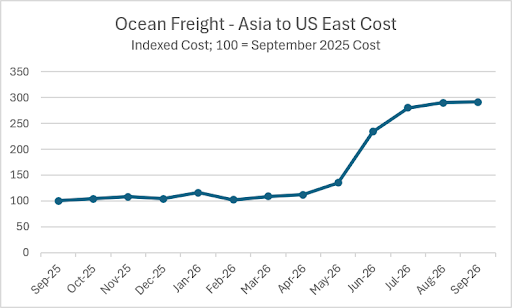
Recent data from Xeneta illustrates just how quickly the market has changed. As of September 10, 2026, average spot rates from the Far East to the U.S. East Coast had increased 313% since February per 40-foot container. Xeneta noted that the market has been affected by the disruption of both the Red Sea and Strait of Hormuz, along with changes in vessel capacity and routing.
Reuters had already reported in June that the cost of shipping containers from Asia to the United States had doubled since February, driven by higher fuel costs and increased demand from importers seeking to get ahead of further cost increases.
Traditional methods of trying to manage these cost increases, such as fixed-rate contracts, are proving ineffective as steam ship lines have stopped accepting sailings or even if accepted, have limited availability for containers to the point that most companies cannot wait for the sailing date. We have also seen that general availability for container bookings is becoming more challenging to obtain, especially in India, where capacity has been diverted to China and elsewhere. It can take on average 4 weeks to obtain a container booking vs historically taking perhaps 1 week at the most.
The chart below, which is indexed against September 2025 freight rates, highlights this increased cost pressure that is affecting all businesses who work internationally. Further, even if a business is not directly sourcing parts from overseas almost every business is indirectly affected as it is estimated by the Federal Reserve that 30% of all intermediate inputs used in US manufacturing are sourced internationally.
What Does This Mean for Manufacturers?
For manufacturers the takeaway continues to be clear that total landed cost needs to be evaluated and all related costs need to be factored into your pricing strategy and decisions and that even sourcing domestically does not insulate a company from these dynamic cost pressures given the overall US economy’s reliance on the global market.
At CSI, we continue to believe that while macro-economic drivers may cause temporary cost increases, the available overseas production capabilities and capacities remain extremely cost competitive options for US manufacturers to leverage. CSI’s broad factory network provides flexibility for our customers to diversify their manufacturing footprint to help mitigate risk and exposure to a single geography.
CSI’s factory network and in-country resources can be counted on to support our customers and ensure reliability across the global supply chain. CSI is committed to continued investments, such as our recent acquisition of SenSource, to add additional capabilities that add value to what we can offer our customers. If you would like to learn more about how CSI can partner with you on your supply chain, reach out.
